Table of Contents
ToggleOwning property in Skyrim has always been a fantasy, literally. While base game players could only purchase pre-built homes in cities, the Hearthfire DLC fundamentally changed what’s possible. Released back in 2012, it still stands as one of the most immersive property ownership experiences in gaming. This guide covers everything players need to know about building and managing their own estates, from selecting the perfect location to staffing your household with followers. Whether you’re a casual player looking for a cozy retreat or a completionist wanting to unlock every buildable feature, Hearthfire offers depth that rewards planning and investment.
Key Takeaways
- Skyrim Hearthfire DLC lets you build and customize three unique homesteads (Lakeview Manor, Windstad Manor, and Heljarchen Hall) with complete control over layout, rooms, and outdoor structures.
- New players should prioritize the greenhouse as your first major structure to enable year-round ingredient farming and maximize self-sufficiency.
- Recruit a steward early to automate tedious resource gathering tasks like quarried stone collection, crop harvesting, and ore processing.
- Marriage, child adoption, and household staff transform Hearthfire into a meaningful family and property management experience that evolves throughout your playthrough.
- Establish profitable crafting operations at your homestead—particularly alchemy and smithing—to generate 100+ gold daily alongside spousal income.
- The Skyrim Hearthfire DLC remains available on all platforms (PC, PS4, Xbox One, Nintendo Switch) and works seamlessly with strategic role-playing builds focused on settlement living.
What Is Hearthfire and Why It Changed Skyrim’s Gameplay
Hearthfire is Skyrim’s second major DLC expansion, introducing player-owned homestead plots across Skyrim. Unlike the static homes available for purchase in major cities, these three buildable properties allow complete customization, from the foundation up. Players construct rooms, furniture, and outdoor structures piece by piece, making each estate truly personal.
The DLC fundamentally shifted how players experienced long-term gameplay. Instead of fast-traveling to a generic purchased home, settlers could develop a functional estate with farms, smithies, and servant quarters. It introduced meaningful property investment and family life mechanics that added roleplay depth. For married players or those adopting children, having a proper home to raise a family became possible in ways vanilla Skyrim couldn’t deliver.
Hearthfire also added new NPC interactions, the ability to recruit household staff, and property-specific quests. The expansion proved so popular that property building became a defining feature in later Elder Scrolls titles. On PC, it remains heavily modded, with community expansions adding thousands of additional furnishings and features. For console players on PS4, Xbox One, and Switch, the vanilla Hearthfire experience remains unchanged since its original 2012 release.
How to Purchase and Install Hearthfire
Hearthfire is available across all Skyrim platforms: PC (Steam, GOG), PS4, Xbox One, and Nintendo Switch. On console, it’s included in the Skyrim Special Edition (PS4/Xbox One) and Switch versions, making it accessible without separate purchase. On PC, purchasing depends on your version.
PC Players:
Steam users can purchase Hearthfire for $4.99 USD from the store page. GOG offers it separately or as part of Skyrim bundles. Simply purchase, and Steam will automatically install the DLC into your Skyrim directory.
Console Players:
PS4 and Xbox One users with Skyrim Special Edition have Hearthfire pre-installed. Switch players likewise get it bundled. No additional purchase is necessary, the DLC content activates once you start a new game or load an existing save.
Activation:
Once installed, you’ll receive an in-game letter from a courier after leaving your starting location (whether Helgen or alternate starts). The letter directs you to speak with a Steward in Morthal’s court (Dawnstar), Balgruuf’s court (Whiterun), or the Jarl’s steward wherever you first travel after the message. This triggers the questline to purchase your first property.
If you don’t receive the letter immediately, try waiting in-game for a few days or fast-traveling to a new location. On rare occasions, quitting to the main menu and reloading solves activation issues.
The Three Buildable Homestead Locations Explained
Each of the three buildable properties offers distinct advantages based on geography, nearby resources, and neighboring settlements. Choosing wisely affects your long-term gameplay experience and resource gathering efficiency.
Lakeview Manor
Located southwest of Falkreath, Lakeview Manor sits on the shores of a peaceful lake with excellent fishing access. The nearby Falkreath region hosts dense forests ideal for wood-cutting, and the town itself has blacksmiths and general goods merchants for resupply runs.
Pros: Abundant lumber (critical for construction), scenic location, access to fresh fish and water plants for alchemy, relatively safe area with few hostile encounters.
Cons: Falkreath is a smaller hold with limited merchant variety. The lake setting means fewer ore deposits nearby compared to other locations.
Best For: Players prioritizing aesthetics and self-sufficiency through farming and woodworking. Ideal if you plan to invest heavily in the greenhouse and vegetable garden.
Windstad Manor
Situated northwest of Morthal’s court in Dawnstar, Windstad Manor overlooks coastal marshland. The location sits in one of Skyrim’s harshest regions, with frequent dragon attacks and hostile creatures. But, the nearby Morthal court and Jarl’s throne room place it in the political heart of the Civil War quest lines.
Pros: Direct proximity to Dawnstar’s court (useful for political roleplay), access to unique mushrooms and marsh plants, dramatic landscape for immersive building.
Cons: Dangerous area with frequent attacks. Limited nearby merchants. Harsh weather and isolation make it feel remote.
Best For: Hardcore players wanting challenge and atmosphere. Those planning heavy use of the alchemy greenhouse will appreciate unique swamp ingredients.
Heljarchen Hall
Located in the frozen Pale, northeast of Whiterun’s sphere of influence, Heljarchen Hall dominates a high-altitude plateau. The location offers stunning mountain vistas and proximity to important holds. Multiple ore deposits (iron, corundum, and rarely gold) surround the property.
Pros: Excellent ore availability for blacksmithing and selling. Close to Whiterun’s markets and merchants. Strategic location between major holds.
Cons: Extreme cold (roleplay immersion). Occasional dragon attacks. Higher monster spawn rates than Lakeview.
Best For: Combat-focused players with smithing ambitions. Those needing regular access to Whiterun’s shops and services while maintaining a remote estate.
Recommendation: New Hearthfire players should choose Lakeview Manor for its balance of safety, resources, and scenic appeal. Experienced players benefit from Heljarchen Hall’s ore deposits and Windstad Manor’s atmosphere.
Estate Building and Customization Features
Construction at your homestead follows a structured progression. You’ll start with the Main Hall (your primary residential building), then unlock additional rooms and structures through sequential building.
Foundation Upgrades and Foundation Additions
Before constructing rooms, you must build the foundation for your Main Hall. This requires specific materials:
Materials per foundation:
- Quarried stone (ore from nearby quarry)
- Iron ingots (smelted from iron ore)
- Nails (purchased or crafted at workbenches)
- Wood (chopped from trees or purchased)
Once the foundation is complete, you can build the Main Hall entrance. From there, you unlock additions to expand the Main Hall itself. These additions include:
- Kitchen Wing – Cooking stations and food storage
- Bedroom Wing – Sleep areas and personal chests
- Cellar – Secret storage and dungeon-like aesthetic
- Enchanter’s Tower – Enchanting table and ingredient storage
- Alchemy Laboratory – Alchemy stations and rare ingredient storage
Each wing costs varying materials. Planning your additions early prevents wasted resources on features you won’t use.
Interior Room Options and Decoration
Once wings are built, you furnish them with interior decorations and functional items. The workbench inside your Main Hall is the hub for all construction.
Functional Furniture:
- Beds (private, guest, child beds)
- Cooking pot and spit
- Enchanting table
- Alchemy lab
- Armor and weapon racks
- Display cases for trophies
- Bookshelves for collection storage
Decorative Items:
- Chairs, tables, benches
- Wall decorations and mounted weapons
- Lighting fixtures
- Tapestries and rugs
- Jewelry boxes and dressers
Decoration costs are minimal compared to structural builds, so don’t hesitate to customize rooms to match your character. A Nord warrior’s estate should look different from a wizard’s tower.
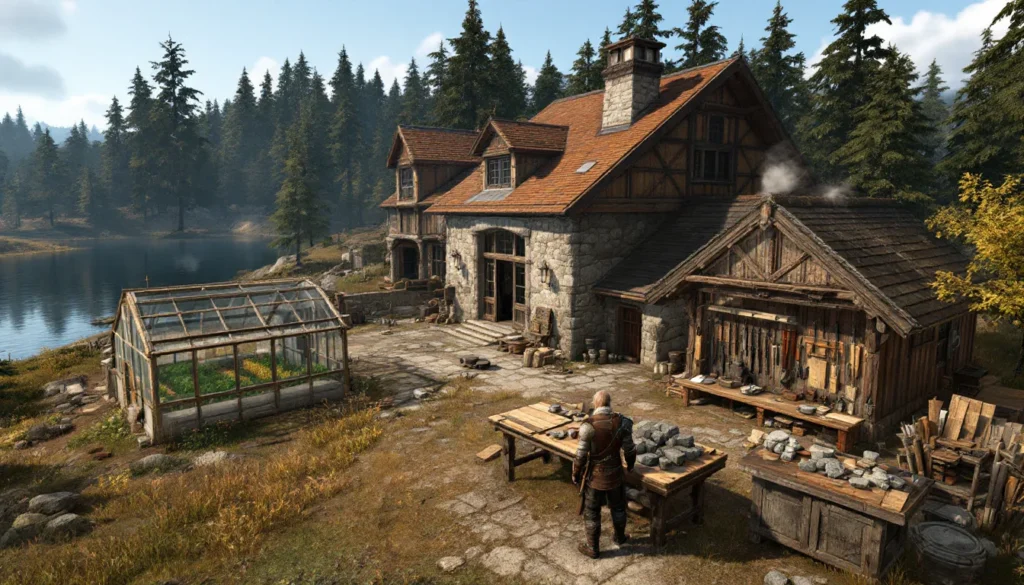
Outdoor Structures and Farm Layout
Beyond the Main Hall, you can construct outdoor buildings that dramatically expand your estate’s functionality.
Available Structures:
- Chicken Coop – Steady egg supply, fresh chicken meat
- Bee Hive – Honey production (alchemy ingredient)
- Greenhouse – Year-round vegetable farming (independent of seasons)
- Mill – Grain processing
- Stable – Horse breeding and storage
- Armory – Weapon and armor storage with display racks
- Shrine – Religious decorations (matches your playstyle)
- Fishery – If near water (limited to Lakeview Manor)
- Smelter – Ore processing (limited to Heljarchen Hall)
The greenhouse is arguably the most valuable structure, it grows ingredients year-round, eliminating the need to forage. Prioritize this early if alchemy or farming appeals to you.
Farm Layout Considerations:
Structures can be placed flexibly around your homestead. Position them logically: place the greenhouse and farm buildings together, your main house in a prominent location, and defensive structures (armory, stable) near entrances. Some players create walled compounds: others spread structures naturally across the landscape.
Resource gathering is essential, you’ll need hundreds of quarried stones, iron ingots, and nails. Plan to visit nearby quarries regularly, and consider hiring a steward to handle some gathering tasks.
Managing Your Household: Spouses, Children, and Followers
Hearthfire transformed Skyrim’s marriage and family mechanics, allowing players to truly settle down and build lives beyond dungeon crawling.
Marriage and Family Life
You can marry virtually any eligible NPC in Skyrim (with specific exceptions for key questline characters). Once married, your spouse moves into your homestead. Marriage provides several practical benefits:
Spouse Benefits:
- Daily income (your spouse generates gold revenue, typically 5–10 gold daily)
- Cooked meals from your spouse
- Enhanced dialogue and roleplay depth
- Shared property ownership and management
To marry someone, complete their personal questline (if required), obtain the Amulet of Mara from Rikke or Dinya Balu at the Temples of Mara, and approach your target NPC when they’re in appropriate locations. Proposal triggers the next step: a wedding ceremony at the Temple of Mara, typically held within a day in-game.
Once married, speak to your spouse about household management. They can help manage the property and occasionally alert you to visitors or issues.
Child Adoption and Education
Hearthfire introduced proper child adoption. Visit any orphanage (Honorhall Orphanage in Riften is most prominent) and speak with the matron. Adoptable children include:
- Lucia (Whiterun orphan)
- Samuel (immigrant child)
- Sofie (Whiterun orphan)
- Runa Fair-Shield (Dawnstar orphan)
Each child has a personality and backstory. Once adopted, they live at your homestead and grow up as you advance time. You can name them and provide education through conversation.
Child Benefits:
- Alchemy ingredient harvesting (children gather ingredients for your alchemy lab)
- Smithing assistance (older children help at the forge)
- Emotional roleplay value
- Inheritance mechanics (your character building a dynasty)
Children require adequate housing (a child’s bedroom in your Main Hall) and spend time at daily activities. Some players report immersion issues with children staying permanently young due to Skyrim’s level scaling, but this remains a popular feature regardless.
Recruiting Stewards and Homesteads Staff
You can recruit NPCs to manage your property and handle resource gathering. This is critical for late-game convenience, stewards automate much of the tedious resource management.
How to Recruit a Steward:
Approach any follower and dialogue to recruit them. Once recruited as a follower, speak to them about managing your homestead. Most followers will agree, though some quest-critical NPCs may decline.
Steward Responsibilities:
- Harvesting crops from your farm
- Collecting animal products (eggs, honey)
- Processing ore at smelters
- Gathering firewood
- Defending your property from attacks
- Providing food and supplies
Stewards don’t actively build, you still construct buildings. They simply handle ongoing resource gathering and defense. This saves enormous amounts of time in late-game playthroughs.
Recommended Stewards:
Look for followers with stealth and combat skills, they’re valuable defenders. Some popular choices:
- Ysolda (Whiterun merchant, business sense)
- Deeja (Orc warrior, strong defense)
- Argis the Bulwark (Markarth follower, excellent fighter)
Once a steward is assigned, they rarely leave your homestead unless you dismiss them through dialogue. Plan steward recruitment carefully, you’ll lose that follower’s active combat role.
Resources, Crafting, and Estate Management
Hearthfire’s building system is resource-intensive. Success depends on efficient material gathering and smart spending.
Materials Gathering and Farming
Construction requires specific materials, each obtained through different methods:
Common Building Materials:
- Quarried Stone – Mine from quarries near each homestead (respawns every few days)
- Iron Ingots – Smelt iron ore at smelters or purchase from blacksmiths
- Nails – Buy from general goods merchants or blacksmiths (approximately 1 gold each)
- Wood Planks – Chop at lumber mills or purchase from merchants
- Clay – Mine from clay deposits or gather near water
Quarried stone is the bottleneck, most structures require 20–30 per building. Plan quarry visits into your schedule. Set a steward to handle gathering if possible.
Farming Output:
Once farms are established, crops grow naturally (though less efficiently than greenhouses). A vegetable garden produces cabbage, potato, and leek. A wheat mill produces flour for bread recipes. Greenhouses multiply your yield significantly.
Crop Types Harvestable:
- Cabbage, potato, leek, wheat, flax, hay
- Special crops via greenhouses (requires special seeds from merchants)
Carpenters, Blacksmiths, and Workbench Access
Your Main Hall includes a workbench for construction, this is where all building happens. The workbench menu organizes construction into logical categories:
- Hall Additions – Upgrade and expand your main building
- Furnishings – Interior decorations and functional items
- Outdoor Structures – Stables, greenhouses, silos, etc.
- Armory – Weapon racks and display cases
- Misc – Miscellaneous decorative items
Each menu shows material costs. Plan builds ahead, calculate total materials needed before committing.
Hiring a Steward to Automate Building:
You can hire a carpenter and blacksmith to speed up construction. Visit Morthal’s (Dawnstar), Balgruuf’s (Whiterun), or the Jarl’s court where your steward works, and hire craftspeople:
- Carpenter – Handles wood-based construction
- Blacksmith – Handles metal-intensive builds
Hiring costs vary (typically 500–1000 gold), but they reduce your material costs and construction time significantly. For high-tier builds, this investment pays dividends.
Storage Organization and Safe Quest Items
Your homestead provides secure storage for valuable items and quest materials. This is crucial for collectors and completionists.
Storage Options:
- Personal chests in your bedroom (safe storage, items never disappear)
- Display cases for weapons, armor, and collectibles
- Wardrobes and dressers for clothing organization
- Bookshelves for book collections
- Alchemy lab storage for potions and ingredients
- Weapon and armor racks for mounted displays
Unlike some in-game locations, your homestead storage is permanently safe. Items stored here will never be removed or despawn. This makes your estate an ideal place to store unique quest items, museum-quality weapons, and rare ingredients.
Pro Tip:
Label your storage mentally, designate specific chests for potions, soul gems, crafting materials, and collectibles. Your homestead can hold thousands of items without consequence, making it an excellent overflow for pack-mule playstyles.
Advanced Tips and Optimization Strategies
Once you’ve established your basic homestead, advanced tactics maximize its potential and unlock hidden depth.
Maximizing Property Value and Defense
Your homestead can become a self-sufficient fortress, this requires strategic building and careful resource allocation.
Defense Optimization:
- Place your armory and stable near the entrance as defensive positions
- Station followers and stewards strategically
- Build defensive structures if mods allow (base game has limited defensive options)
- Use the cellar as a panic room during attacks
Your steward serves as your primary defender. Combat-capable stewards (warriors, archers) handle most threats. For added security, keep 1–2 combat followers stationed at your homestead.
Property Value Maximization:
Your homestead doesn’t generate direct wealth like taverns or shops, but it maximizes your playstyle efficiency:
- Alchemy Greenhouses – Herb harvesting produces valuable potions (profit from selling)
- Smithing Setup – Craft weapons and armor for sale (significant income)
- Spouse Income – Daily gold accumulation
- Storage Efficiency – Free up inventory space for loot gathering
A fully upgraded estate with active farming, alchemy, and smithing can generate 100+ gold daily through crafting and spousal income combined.
Hidden Quests and Easter Eggs in Hearthfire
Hearthfire includes subtle content that rewards exploration and specific choices.
Hidden Quest Elements:
- The Necromancer’s Amulet – Can be hidden in your homestead’s cellar (involves dark magic roleplay)
- Adoption-Specific Dialogue – Each child has unique conversations and personality quirks based on their background
- Spouse Interactions – Married couples develop dynamic relationships: some spouses reference their past lives
According to comprehensive gaming guides from IGN, players who explore dialogue trees with their spouses and children unlock emotional moments and character development unavailable elsewhere.
Easter Eggs:
- Sometimes your steward comments on your estate’s condition or construction progress
- Children occasionally have nightmares or express fears from their past (emotional storytelling)
- Spouses may reference events from their original questlines during daily conversations
Optimization Easter Egg:
If you build all three homesteads simultaneously (possible with multiple characters or tedious resource gathering), you unlock a unique dialogue option with stewards mentioning your “vast holdings.” It’s a minor detail, but rewards dedicated players.
Community-Discovered Content:
After 14 years, community wikis have documented virtually every Hearthfire detail. Resources like GamesRadar+ guides catalog specific material costs, optimal building sequences, and hidden interactions. Check these if you’re pursuing 100% completion.
Mod Integration Note:
PC players have access to thousands of Hearthfire mods, from quality-of-life improvements (reduced material costs) to complete overhauls (new homesteads, expanded features). Consoles lack mod access, so your vanilla experience is the base described here.
Conclusion
Hearthfire remains one of Skyrim’s most compelling expansions precisely because it offers what the base game never could: genuine home ownership and family life. The three buildable homesteads provide distinct experiences, from Lakeview Manor’s peaceful lakeside living to Heljarchen Hall’s mountainous isolation. Whether your goal is creating a cozy farmstead, establishing a blacksmith empire, or raising a family in a remote estate, Hearthfire delivers the infrastructure to realize it.
The expansion shines through its flexibility and longevity. A homestead built early in your playthrough remains relevant hundreds of hours later, it evolves with your character from adventurer to established landowner. The addition of spouses, children, and household staff transforms Skyrim’s endgame from aimless wandering into purposeful settlement building.
For new players, start with Lakeview Manor, prioritize the greenhouse, and recruit a steward early to automate resource gathering. For veterans, optimize your build sequence, establish profitable crafting operations, and embrace the roleplay of being Skyrim’s most successful property owner. Either way, Hearthfire elevates what’s possible in a single-player RPG. In 2026, it still stands as proof that DLC can fundamentally reshape how players experience a game.