Table of Contents
ToggleSkyrim has been a cultural juggernaut since 2011, spawning countless mods, ports, and spin-offs. But in 2024, something unexpected happened: the frozen tundras of the fifth Elder Scrolls game made the leap from screen to tabletop. The Skyrim Adventure Board Game delivers a surprisingly faithful translation of Bethesda’s open-world formula into a cooperative dungeon-crawling experience. Whether you’re a hardcore TTRPG veteran or a casual Skyrim fan looking to scratch that dragon-slaying itch away from your PC or console, this board game offers genuine depth and replayability. We’ll walk you through everything you need to know, from mechanics and components to whether it’s worth the investment in 2026.
Key Takeaways
- The Skyrim board game is a cooperative dungeon-crawling experience that successfully captures the spirit of the video game with streamlined mechanics designed for 1-4 players, playing best with 2-3 participants.
- Character progression through skills and perks mirrors the video game system, rewarding earned advancement and offering diverse build options from combat-focused abilities to utility-focused perks.
- Modular hex tiles, procedurally-varied dungeons, and deck-based randomness ensure high replayability, making each scenario feel distinct without requiring expansion purchases.
- The game strikes a middle ground between narrative-focused dungeon crawlers and tactical RPGs, offering more exploration flavor and character depth than Diablo but remaining lighter and more accessible than Gloomhaven.
- At $60-80 for the core box, the Skyrim board game delivers solid value for fans of the video game, cooperative board gaming, or exploration-focused gameplay, with ongoing expansion support extending its content pipeline.
What Is The Skyrim Board Game?
The Elder Scrolls: Skyrim Adventure Board Game is a cooperative dungeon-crawling tabletop experience published by Modiphius Entertainment in partnership with Bethesda. It retains the core identity of Skyrim while adapting it for 1-4 players (though it plays best with 2-3) in physical space.
Unlike turn-based strategy games, Skyrim‘s board game adapts the exploration and combat model from the video game itself. Players control custom or predetermined characters, equip weapons and armor, level up skills, and venture into procedurally-varied dungeon scenarios. The game emphasizes narrative flavor and replayability over rigid tournament-style rules, which means every playthrough feels distinct.
It’s worth noting that this isn’t a faithful 1:1 conversion of the digital game. Instead, it captures the spirit, the exploration, the loot loop, the progression fantasy, and packages it in a format that works around a table. If you’ve played the video game, you’ll recognize ability names, enemy types, and loot structures. But the mechanics themselves are streamlined for tabletop play.
Core Gameplay Mechanics
Combat and Exploration Systems
Combat in the board game revolves around a challenge-based system rather than traditional grid-based movement. When your character encounters an enemy, you draw from a combat deck and resolve encounters using dice rolls modified by your equipment and skills. Each enemy has a difficulty rating, and you’re comparing your attack roll against it.
The exploration phase is where the magic happens. Players move through dungeon tiles that reveal as you progress, discovering loot, enemies, and interactive elements (traps, puzzles, shrines). The procedural nature means you won’t face the same dungeon layout twice, tiles are shuffled and randomized based on scenario cards.
Damage is tracked via a simple system: you have health tokens, and damage tokens reduce your pool. Unlike many board games that use track-based health, Skyrim uses a token economy that feels more tactile and immediate. Healing potions are consumable resources, just like in the video game, so resource management matters.
Character Progression and Skills
Each character sheet includes multiple skill tracks: One-Handed, Two-Handed, Archery, Destruction, Restoration, and more. As you complete encounters, you earn experience that advances these skills. The progression feels earned, not handed out arbitrarily.
Leveling works incrementally, you gain one rank in a skill each time you fulfill a condition (defeating enemies with a specific weapon type, casting spells, etc.). Once you accumulate enough skill ranks, your character levels up, granting an attribute increase (Magicka, Stamina, Health) and sometimes a perk that mirrors the video game’s system.
Perks are the real meat of progression. Instead of generic bonuses, perks have flavor, Barbarian grants bonus damage with two-handed weapons, Eagle Eye increases ranged damage, Elemental Explosion triggers AOE effects with destruction spells. The perk list feels curated from the video game’s actual perk trees, which resonates with fans.
Game Components and What’s Included
Board Layout and Miniatures
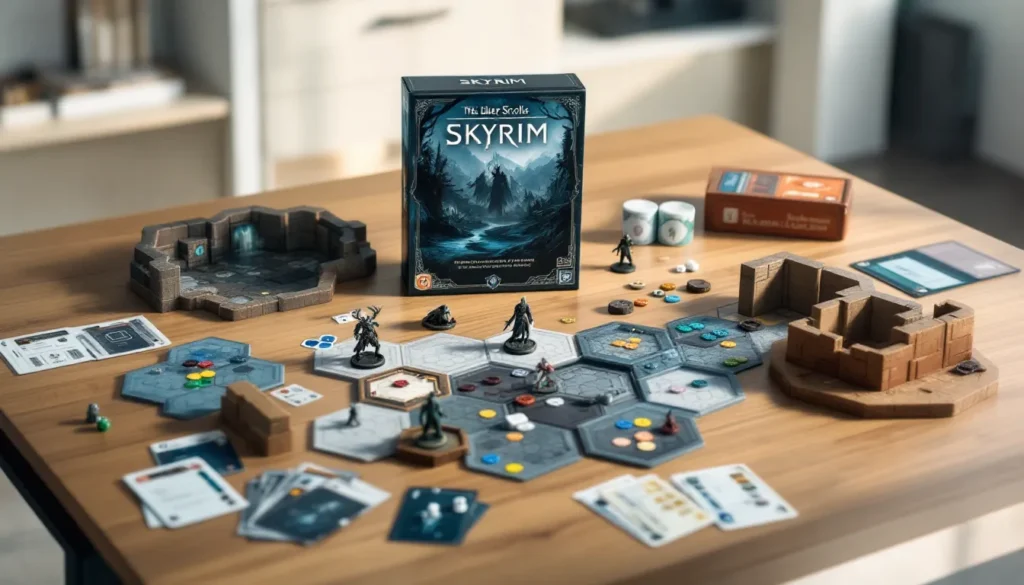
The Skyrim board game ships with a modular board system. Instead of a single permanent board, you construct dungeons using hex tiles as you explore. This modular approach ensures that no two games feel identical, even the same scenario can generate different layouts.
Miniatures are included for your characters and common enemies (Draugr, Bandits, Skeevers, Dragons, etc.). The sculpts are detailed enough to be satisfying without being showcase-quality, they’re functional and thematic. You’ll also get enemy tokens for encounters that don’t warrant a miniature (like projectile attacks or summoned creatures).
The core box includes a large cardboard shield that serves as a folding screen, the “Dungeon Master” (Overlord in cooperative mode) uses it to hide information, though the game can be played fully openly if players prefer.
Cards, Tokens, and Rulebooks
Expect a lot of cards: encounter decks, loot decks, quest cards, and ability cards. The deck-heavy design keeps the game feeling dynamic. You’re constantly drawing new challenges and rewards, which mirrors the video game’s random loot philosophy.
Tokens include health, stamina, magicka, experience, and condition markers (poisoned, weakened, etc.). The token management is straightforward, not fiddly, but it does require table space.
Rulesets come in two forms: a quick-start guide for jumping in fast, and a comprehensive rulebook for resolving edge cases and variant rules. The writing is clear and scenario-focused, which beats rulebooks that bury the fun in jargon. Setup typically includes scenario-specific cards and modular elements, but nothing overly complex.
Player Count, Setup Time, and Game Duration
The game accommodates 1-4 players, though the sweet spot is 2-3. With four players, turns can drag slightly, and downtime increases. Solo play works but requires accepting that it’s more puzzle-solving than narrative adventure.
Setup takes 15-20 minutes for experienced players, longer for your first session. You’re organizing decks, placing miniatures, distributing character sheets, and reviewing the scenario card. It’s not egregious, but it’s not a grab-and-play affair either.
Game duration averages 60-90 minutes per scenario. Some quick scenarios finish in 45 minutes: deeper ones push toward two hours. This is reasonable for a cooperative board game and matches the table’s typical attention span.
One consideration: the game’s modular nature means you can pause mid-scenario and resume later, which is practical for longer campaigns. The campaign structure supports this, with persistent character progression across sessions.
Strategy Tips for New Players
Character Selection and Build Planning
Character selection matters more than you’d think. The box includes pre-generated characters or allows you to build custom ones. If you’re new, grab a pre-gen and note their starting bonuses, they’re balanced but flavored.
Think about your team composition. A group with no healing (Restoration) will struggle on harder scenarios. Conversely, a group with two mages and no physical damage dealers might get bogged down in lengthy combat. The game doesn’t mandate a strict party comp, but diversity in damage types and utility matters.
Look at your character’s starting perks. Some are combat-focused (bonus damage), others utility-focused (extra inventory space, cheaper potions). In early scenarios, grab perks that feel strong immediately: as you understand the game better, branch into synergistic builds. A mage should probably invest in Destruction and Restoration early, while a warrior commits to weapon mastery.
Effective Resource Management
Your magicka, stamina, and health pools are finite. Unlike the video game where you can rest to refill, board game resources are limited by consumables and rest tokens (which consume turns). Don’t spam your best spell early, spread your abilities across the encounter.
Potion economy is crucial. Healing potions are lifelines, but they’re also limited. Use them strategically: heal when you’re low enough that the next hit ends your run, not preemptively. Stamina potions enable ability spam, but they’re rarer, reserve them for climactic fights.
Loot prioritization should lean toward synergy. A crossbow that deals extra damage to specific enemy types is better than a generic +1 damage sword if you’re fighting lots of undead. Read loot cards carefully, the subtle bonuses matter.
Finally, know when to flee. Some encounters aren’t meant to be won head-on. If a scenario offers an exit route and you’re badly wounded, taking it is valid strategy, not failure.
How Does It Compare to Other Fantasy Board Games?
The Skyrim board game operates in the space between narrative-focused dungeon crawlers and tactical RPG board games. It’s lighter than something like Gloomhaven (which demands careful positioning and long-term planning) but heavier than push-your-luck games like King of Tokyo.
Its closest spiritual cousins are cooperative dungeon crawlers like Shadows of Brimstone or Zombicide, which prioritize exploration, loot, and character progression. Unlike those, Skyrim leans into fantasy IP and video game mechanics, which either resonates or doesn’t depending on your group.
Skyrim vs. Diablo Board Game
If you’re choosing between the Skyrim board game and Diablo board game, understand their core differences. Diablo: The Board Game (published by Asmodee) is more tactical, it emphasizes positioning, hand management, and strategic combat. It’s tighter mechanically but less modular in structure.
Diablo board games tend toward faster play (45-60 minutes) and are more welcoming to new players who haven’t played the Diablo games. They’re also slightly cheaper and more frequently discounted.
Skyrim offers more exploration flavor, deeper character progression, and campaign continuity that Diablo doesn’t quite match. If you want to live a dungeon crawl, Skyrim wins. If you want tight, tactical combat, Diablo edges ahead.
Both support 1-4 players, both have expansion content available, and both work solo. The choice comes down to whether you value thematic immersion or mechanical elegance more. Notably, gaming journalism outlets have rated both favorably for their respective designs, though Skyrim edges out in accessibility for video game players.
Expansions and Additional Content
Available Expansions and Storyline Modules
Modiphius has released several expansions since the game’s initial launch. The Dragonborn Expansion adds dragon encounters with unique mechanics, dragon encounters are multi-phase battles with distinct tactics. You’re not just rolling dice: you’re managing fire breath patterns and wing attacks.
The Lost Dwemer expansion introduces Dwemer ruins with puzzle-heavy encounters and unique loot. If your group enjoys problem-solving, this scratches that itch better than pure combat.
There’s also Daedric Invasion, which shifts the game toward larger-scale threats. Encounters become more demanding, and you’re defending locations rather than just advancing through dungeons. It’s a thematic shift worth experiencing if you’ve mastered the core game.
Standalone scenario packs are released regularly, smaller modules focused on specific regions (the Reach, Morrowind content) or enemy types (Vampire-heavy campaigns, Werewolf hunts). These run $20-30 and are excellent for extending gameplay without the financial commitment of full expansions.
Notably, the base game remains viable without expansions. You’re not missing core mechanics by sticking with just the box. Expansions add variety and new challenge, not essential content.
Is It Worth Buying in 2026?
By 2026, the Skyrim board game has proven its staying power. It’s not a fad product, it has genuine community engagement, regular expansions, and a player base that’s grown rather than shrunk. The question is whether you should buy it.
The core box costs $60-80 depending on retailer. That’s mid-range for modern board games. Expansions run $30-50. It’s not cheap, but it’s comparable to other cooperative dungeon crawlers of similar quality.
The value proposition is solid if you’re a Skyrim fan who plays board games, or a board game enthusiast who likes fantasy IP. Video game enthusiasts and casual tabletop players often find cross-platform appeal here, the video game experience primes you for the mechanics, while the board game format offers something the digital version doesn’t: shared table time with friends.
If you’re playing solo or with one other person regularly, the game shines. If you have a rotating group of four or more, downtime might be a drawback. If you’re strictly a Eurogame fan (think Catan, Carcassonne) and have zero interest in Skyrim, you’ll probably find it too thematic and random.
Who Should Play This Game?
You’re a good fit for Skyrim board game if you:
- Have played Skyrim or other Elder Scrolls games and enjoyed them
- Play cooperative board games and want something thematically strong
- Enjoy character progression and RPG mechanics in tabletop form
- Prefer exploration-focused gameplay over strict tactical puzzle-solving
- Want a game that supports solo play or plays great with 2-3 people
- Don’t mind a modest amount of randomness in encounters
You might want to pass if you:
- Dislike fantasy themes or Skyrim specifically
- Prefer purely competitive games or pure competitive modes
- Want quick games (under 30 minutes)
- Prefer games where skill completely dominates luck
- Are on a tight budget and can’t justify $60+ on a niche product
If you’re on the fence, watch a playthrough video before committing. The gameplay loop should feel immediately familiar to Skyrim players and reasonably intuitive to tabletop fans.
Conclusion
The Elder Scrolls: Skyrim Adventure Board Game successfully translates video game design into a cooperative tabletop experience. It doesn’t try to be a perfect simulation, it’s a thematic adaptation that captures the vibe of exploring ancient dungeons, collecting loot, and watching your character evolve. The mechanics are accessible, the components are solid, and the replayability is genuine thanks to modular design and deck-based randomness.
In 2026, this game has earned its place in the board game ecosystem. It’s not the best cooperative dungeon crawler by pure mechanics, but it might be the best for Skyrim fans and those seeking exploration-focused gameplay. With multiple expansions available and ongoing support from Modiphius, the content pipeline keeps things fresh.
If you’re curious about board games and already know you love Skyrim, the core box is a solid entry point. If you’re new to cooperative board games, this is more inviting than heavily tactical alternatives. And if you’re already deep in the tabletop hobby, it’s a worthwhile addition that offers something distinct from your existing collection.
Grab it, round up a friend or two, investigate into a dungeon, and see if your character can make it out with treasure and their head still attached. That’s the Skyrim board game experience in a nutshell.